 London, England
You can click on any picture to see it larger
Kensington Palace
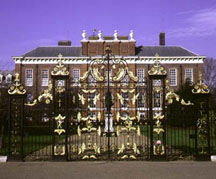 Next was Kensington Palace to see the State Apartments and the exhibit of Princess Diana's dresses.
Kensington Palace was constructed in 1605 (then home to the 2nd Earl of Nottingham), then in 1688 it was converted (and added on, redecorated) to the Royal Palace at Queen Mary's request (Queen Victoria was born there) and remained the Royal Palace for 70 years. Today parts of the palace remain a private residence for memebers of the Royal Family (Princess Di lived here). We took the audio tour of the apartments and saw some of the clothing from Royal Dress Collection showing the styles over the years (not very comfortable looking).
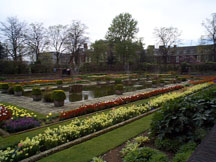
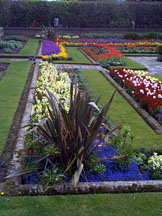
This is the Sunken Garden at Kensington Palace and it was incredibly beautiful.
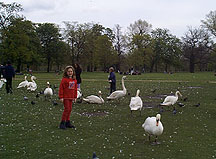
 Of course there was a small lake with ducks and geese, so Mackenzie had to head over. Luckily we didn't have any food or we would have been there for awhile. You could see the rain coming so we decided to head back, but not before grabbing an ice cream cone.
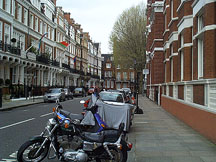
This is just across from Hyde Park and Kensington Palace named Prince's Gate, it was just a cute street.
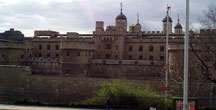
 The next morning we took off for the Tower of London to see the Crown Jewels and Traitors Gate (prisoners were bought by boat along the Thames through Traitors Gate). This is the place where Henry VIII had two of his alledged adulterous wives, Anne Boleyn and Catherine Howard (2 of 6 wives), beheaded and Sir Walter Raleigh was imprisioned.
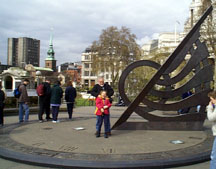
Grampa and Mackenzie are on the sundial which is just outside the tube station across from the Tower. It depicts the history of London from 43 to 1982.
The Tower of London was constructed in 1078 when William the Conquerer laid the first stone of the White Tower to replace the earth and timber castle he'd already built on that same site.
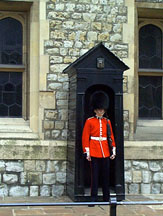
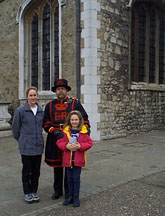
The Yeoman Warders give tours and answer questions and are all over the place. They ended up with the name Beefeaters in the olden days (they've been there since the 14th century) when they lived within the Tower and were fed beef. Modern Yeoman Warders (of whom there are about 40) are still Extraordinary Members of the Queen's Bodyguard and are all former warrant officers from Her Majesty's Forces with an honourable service record of at least 22 years and actually still live in the Tower of London (about 150 people live their including the families of the Yeoman, a Tower Doctor, Chaplain and Resident Govenor).
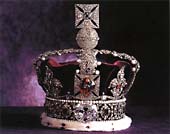
 The Imperial State Crown was made for the coronation of George VI in 1937 and altered for Queen Elizabeth II in 1953. It is set with 2,868 diamonds (including the Koh-i-Noor diamond), 17 sapphires, 11 emeralds, 5 rubies and 273 pearls.
The First Star of Africa (Cullinan I) is the largest cut diamond in the world at just over 530 carats sits in the head of the Sceptre with the Cross.
The Imperial State Crown was made for the coronation of George VI in 1937 and altered for Queen Elizabeth II in 1953. It is set with 2,868 diamonds (including the Koh-i-Noor diamond), 17 sapphires, 11 emeralds, 5 rubies and 273 pearls.
The First Star of Africa (Cullinan I) is the largest cut diamond in the world at just over 530 carats sits in the head of the Sceptre with the Cross.
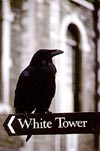
Legend has it that Charles II was told that if the Ravens left the Tower, the monarchy would fall, so he ensured that a limited number would be kept here permanently, they clip their wings.
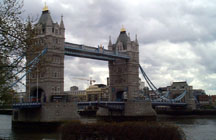
The Tower Bridge was built in 1894, closed to public access in 1910 and only re-opened in 1982. They held a competition to design a new bridge to cross the Thames in 1876 (London Bridge was the first bridge in 1209 and was the lone bridge for centuries). Tower Bridge is perhaps most famous because it lifts to let tall ships pass under it. This design is called a 'bascule' bridge from the French for 'see-saw.' The bascules were designed to lift by using hydraulically powered driving engines.
Today hydraulics are still used but they are driven by oil and electricity. The Bridge was designed to allow pedestrian access even when the bascules were lifting. The walkway which runs between the towers is 800 feet long
On to Brass Rubbings